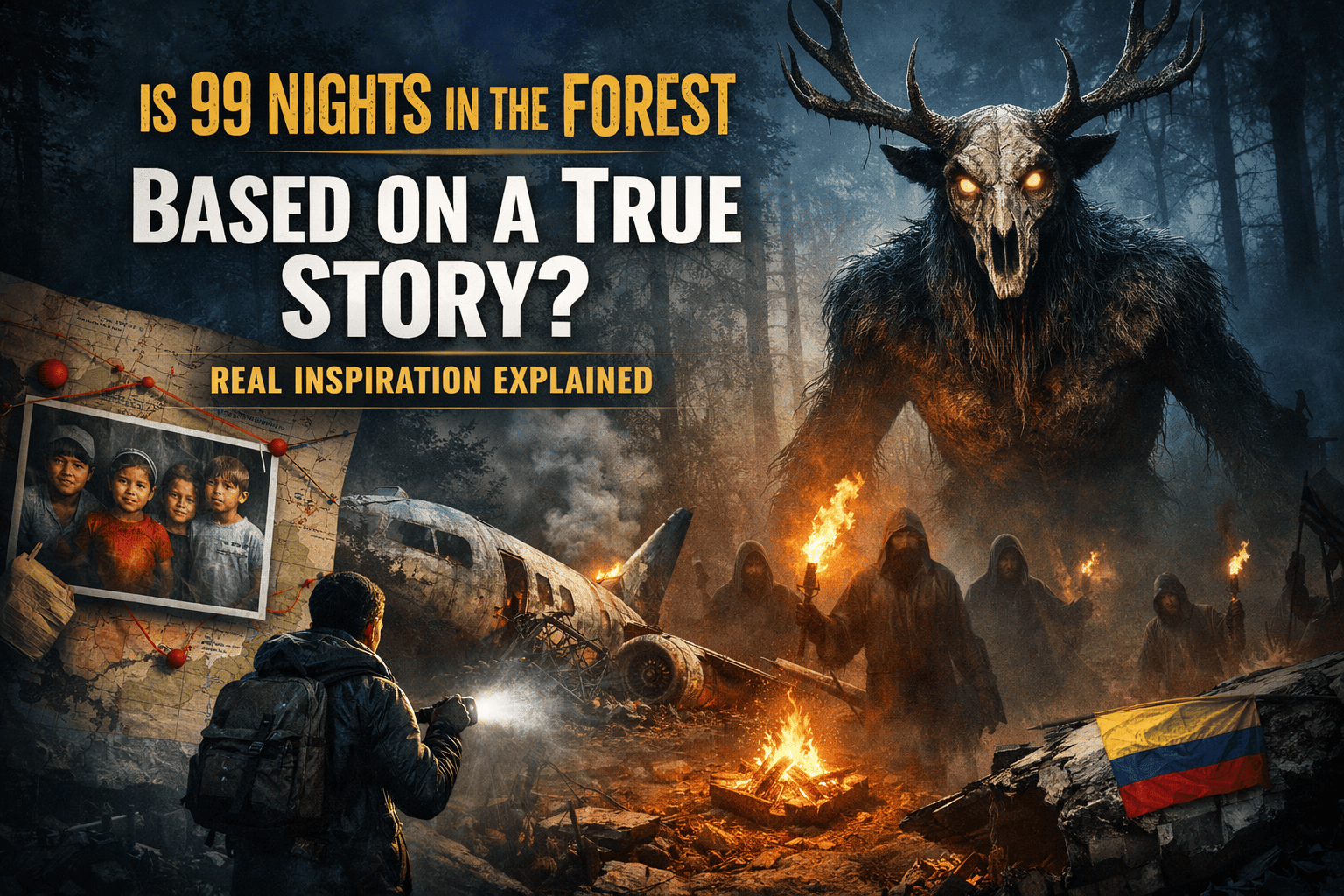
When you load 99 Nights in the Forest on Roblox, the game claims it is “based on a true story,” which has led many players to wonder how much of it is real. While the game features a supernatural deer monster, hostile cultists, and horror gameplay, its central premise is inspired by a real-life survival incident from 2023, when four children survived for 40 days in the Colombian Amazon after a plane crash and were later rescued during Operation Hope, a major search effort by the Colombian military. That real-life event is not a story of monsters, but one of courage, indigenous survival knowledge, and the will to survive against impossible odds—and it provides the emotional foundation of the game. The monsters, cults, and hidden research facilities, however, belong entirely to the game’s own fictional canon, heavily influenced by the survival horror video game The Forest.
What Does the Game’s “Based on a True Story” Message Mean?
When 99 Nights in the Forest says it is “based on a true story,” it is not claiming to recreate real events exactly as they happened. Instead, the message explains where the idea behind the game comes from.
The phrase signals that the core premise—four missing children and a desperate rescue in a dangerous forest—was inspired by something real. However, everything players experience inside the game, including monsters, cultists, night attacks, and supernatural threats, exists entirely within the game’s fictional canon.
In simple terms, the label is about inspiration, not accuracy. It gives the story emotional weight without suggesting that the gameplay or lore represents real history.
What Is 99 Nights in the Forest Based On?
99 Nights in the Forest draws from two primary sources of inspiration, each serving a different purpose.
First, the game’s premise and emotional foundation are inspired by a real-life survival incident involving four missing children and a large-scale rescue effort. This is where the game gets its rescue-focused narrative and sense of urgency.
Second, the game’s horror design and gameplay systems are inspired by fictional sources, most notably the survival-horror video game The Forest. Elements such as hostile enemies, base-building, crafting, and surviving increasingly dangerous nights come from this influence rather than real events.
Together, these inspirations explain why the game feels grounded in reality while still functioning as a full horror experience.
Is 99 Nights in the Forest a True Story?
Yes, 99 Nights in the Forest is inspired by a real-life survival story, but it is not a literal or historical retelling.
The game draws from the 2023 Colombian Amazon plane crash, in which a small aircraft carrying seven people went down in the rainforest. All three adults on board — including the pilot and the children’s mother — were killed in the crash. The only survivors were four siblings aged 13, 9, 4, and just 11 months old.
After the crash, rescue teams reached the wreckage but found no sign of the children. With no roads, no communication signal, and dense jungle in every direction, the situation looked bleak. Despite this, the Colombian military launched a large-scale search effort later known as Operation Hope.
For 40 days, the children survived alone in the rainforest. In the early days, they lived on cassava flour recovered from the wreckage. When that ran out, they relied on fruits, seeds, and edible plants they could identify in the forest. The eldest sibling, Lesly Jacobombaire Mucutuy, used survival knowledge passed down through her Indigenous Huitoto (Witoto) heritage to help her younger siblings avoid poisonous plants and stay alive.
The children built simple shelters from branches, moved carefully to avoid predators such as snakes and jaguars, and stayed together as they navigated the jungle. Over time, search teams began finding small but critical signs of life, including footprints, a baby bottle, and makeshift shelters. On June 9, 2023, after 40 days in the rainforest, all four children were found alive — weak and malnourished, but safe.
This real-life survival story forms the emotional and thematic foundation of 99 Nights in the Forest. However, everything beyond that core premise — including monsters, cultists, supernatural threats, and hidden facilities — belongs entirely to the game’s fictional universe.
Is 99 Nights in the Forest Based on Multiple True Stories?
No. Despite online rumors, 99 Nights in the Forest is not based on multiple real-life incidents. There is no verified Japanese case, 1970s survival story, or alternate historical event connected to the game. The only real-world incident consistently cited by major publications and researchers is the 2023 Colombian Amazon survival story involving four children.
All other elements often discussed online — including monsters, cults, secret experiments, and supernatural forces — come from fictional storytelling, folklore, and survival-horror game influences, not real events.
Developer confirmation / lack of official statement
The developers have not released an official statement confirming the exact real-world inspiration behind 99 Nights in the Forest. However, the similarities between the game’s premise and the 2023 Colombian Amazon survival story are widely recognized and referenced by major publications and players.
Who Were the Real Children Behind the Story?
TThe real-life event that inspired 99 Nights in the Forest involved four siblings from the Huitoto (Witoto) Indigenous community in Colombia.
After a plane crash deep in the Amazon rainforest in 2023, the children survived alone for 40 days before being rescued. They were:
- Lesly Jacobombaire Mucutuy (13) – the eldest sibling, whose Indigenous survival knowledge helped keep the group alive
- Soleiny Jacobombaire Mucutuy (9)
- Tien Ranoque Mucutuy (4)
- Cristin Ranoque Mucutuy (11 months)
Led by Lesly, the siblings relied on ancestral knowledge to identify safe food, avoid poisonous plants, and navigate the rainforest. They stayed together, built basic shelters, and moved carefully through the jungle until they were finally found during Operation Hope, the Colombian military’s large-scale rescue mission.
How This Real Story Connects to 99 Nights in the Forest Roblox Game
The connection between the real-life survival story and 99 Nights in the Forest lies in structure, not direct storytelling.
Players do not play as the children. Instead, they take on the role of rescuers sent into a hostile forest to locate four missing children before time runs out. This mirrors the real-world rescue effort, where search teams navigated vast terrain with limited clues and no certainty of success.
Several in-game elements reflect this framework:
- A crashed plane that acts as a narrative anchor
- Environmental clues that guide exploration
- A strong emphasis on time, survival, and persistence
Where the game diverges is in tone. In real life, danger came from starvation, weather, wildlife, and exhaustion. In the game, those fears are transformed into horror mechanics — monsters replace predators, darkness becomes a threat, and survival becomes a nightly struggle.
This balance allows the game to feel grounded while still functioning as a horror experience.
Is “99 Nights in the Forest” based on the game “The Forest”?
Yes. 99 Nights in the Forest clearly draws inspiration from the survival-horror game The Forest, particularly in gameplay design and atmosphere.
Both games share:
- A plane crash as the inciting event
- A hostile forest environment
- A focus on resource gathering, shelter, and survival
- Increasing danger during nighttime
Enemy behavior also follows similar patterns. Hostile groups attack on sight, abandoned structures hint at past experiments, and the environment itself tells a story through exploration.
The Deer in 99 Nights in the Forest fills a role similar to the mutant enemies in The Forest. It is difficult to defeat, appears primarily at night, and forces players to rely on avoidance, light, and preparation rather than direct combat.
Rather than copying The Forest, the game adapts its ideas into a format suited for Roblox.
What Is the Canon Lore of 99 Nights in the Forest?
Within the game’s universe, 99 Nights in the Forest has its own fully fictional canon lore.
According to in-game notes and environmental clues:
- The forest was once used as a secret research facility
- Experiments on animals led to unnatural mutations
- One experiment resulted in the creation of the Deer
- Cultist groups later formed around this creature, worshipping it
These elements explain the presence of hostile enemies, ritual sites, and abandoned facilities throughout the map. None of this lore has any connection to the real Amazon survival incident.
Where does 99 Nights in the Forest leave reality behind?
This is the point where 99 Nights in the Forest fully steps away from real life. In the real Amazon survival story, there were no monsters stalking the children at night. No cultists guarding caves. No supernatural force controlling the forest. The dangers were painfully real — hunger, exhaustion, wild animals, and the constant risk of getting lost. The game, however, takes those real fears and turns them into horror gameplay with most obvious fictional addition: The Deer.
Is the Deer real?
No. The Deer is not real and has no connection to the 2023 Amazon survival story. In 99 Nights in the Forest, The Deer is likely drawn from the legend of the Wendigo. It is a towering, two-legged creature that appears after dark, hunting players relentlessly. Weapons barely slow it down, and the only real defense is Light (from flashlights or campfires) that will stun it, and staying close to your base.
This creature has no basis in the real 2023 Amazon incident. Instead, it appears to draw inspiration from horror folklore, particularly the Wendigo and other “not-deer” legends, where familiar animals are twisted into something deeply unsettling.
Are the cultists real?
The cultists are another invention. Throughout the game, players encounter hostile cultist groups that worship the Deer and actively try to stop the rescue effort. These enemies add tension and combat, but they are entirely fictional. In reality, rescue teams faced logistical challenges, harsh terrain, and time working against them — not human enemies hiding in the forest.
There’s also the game’s deeper lore involving secret experiments and research facilities hidden within the woods. Notes and environmental storytelling hint that the Deer may be the result of unnatural experimentation. This storyline doesn’t connect to the real Amazon crash at all, but it helps explain the game’s horror elements and gives players a reason for why the forest feels corrupted and hostile.
In short, once the basic premise is established — four missing children and a dangerous forest — everything else is designed to serve gameplay and atmosphere. The fear, the monsters, and the cultists exist to keep players on edge, not to retell the real-world story. And that distinction matters.
Why the Developers Didn’t Retell the Real Story
The developers didn’t recreate the real Amazon survival story exactly — and that was likely a deliberate choice.
The 2023 incident involved real children, real loss, and a very real tragedy. Turning that story directly into a horror game with monsters, cultists, and night attacks would have felt disrespectful. Instead of copying what actually happened, the game borrows only the basic idea and builds something fictional around it.
That’s why the children in the game don’t have real names or detailed backstories. The forest isn’t a real location. And the dangers players face aren’t realistic threats like hunger or wildlife — they’re supernatural enemies designed for gameplay.
By keeping that distance, the game avoids exploiting the real people involved while still using the emotional weight of the situation. It also explains the message players see when they start the game. When 99 Nights in the Forest says it’s “based on a true story,” it’s not claiming to retell real events. It’s letting players know that the premise — lost children and a desperate rescue — comes from something that actually happened, even if everything built around it is fictional.
Frequently Asked Questions (FAQs)
Is 99 Nights in the Forest based on a real story?
Yes, partly. 99 Nights in the Forest is inspired by a real-life survival incident from 2023, when four children survived alone in the Colombian Amazon rainforest after a plane crash. However, the game itself is fictional. The monsters, cultists, and supernatural events were created for horror gameplay and are not part of the real story.
Is The Forest movie based on a true story?
No. The movie The Forest is not based on real events. It is a fictional horror film loosely inspired by Japanese folklore and myths surrounding Aokigahara Forest. It has no connection to the real-life survival incident that inspired 99 Nights in the Forest.
Are any of the real children from the Amazon survival story still alive?
Yes. All four children who survived the 2023 Colombian Amazon plane crash were found alive after 40 days in the rainforest. They were malnourished but survived thanks to Indigenous survival knowledge and were rescued during Operation Hope. Their story is real and well-documented.
What is the lore of the Deer in 99 Nights in the Forest?
Within the game’s fictional lore, the Deer is believed to have been part of a secret experiment conducted in a hidden research facility deep in the forest. According to in-game notes and environmental clues, the animal was mutated into a larger, violent, humanoid creature. After the experiment went wrong, the Deer escaped and later became the central threat players face.
This lore exists only inside the game’s universe and has no basis in real-life events.
Is The Deer Hunter based on a true story?
No. The film The Deer Hunter is not based on a true story. It was adapted from a fictional screenplay and later set during the Vietnam War. While it portrays realistic themes, several scenes—most famously the Russian roulette sequences—were heavily criticized for historical inaccuracies.
It has no connection to 99 Nights in the Forest.
Who created 99 Nights in the Forest?
Alec Kieft, also known online as Cracky4, is one of the developers behind 99 Nights in the Forest. He is also known for creating popular Roblox games such as Break In and Break In 2. The game quickly became one of Roblox’s most-played survival titles after release.
Is the Deer in 99 Nights in the Forest real?
No. The Deer is entirely fictional. It has no connection to the real 2023 Amazon survival incident and was created specifically as a horror antagonist within 99 Nights in the Forest.
While its appearance may feel unsettlingly realistic, the Deer is inspired by horror folklore, including Wendigo myths and modern “not-deer” legends commonly used in survival-horror games. It exists only to create tension, fear, and gameplay challenge—not to represent any real animal, event, or creature.
Is the game meant to retell the real Amazon incident?
No. The developers did not attempt to recreate the real story directly. Instead, they used the idea of lost children and a dangerous rescue as inspiration, then built a separate fictional horror world around it. This approach avoids turning a real tragedy into a literal horror narrative.
Bottom Line: Is 99 Nights in the Forest a True Story?
“99 Nights in the Forest” is inspired by a real-life survival event—the survival of four siblings who lived for 40 days in the Colombian Amazon after a plane crash in 2023. That real incident closely matches the game’s core premise of rescuing four missing children from a dangerous forest.
However, most of the details players encounter in the game are fictional. Elements such as the Deer monster, hostile cultists, supernatural threats, and hidden research facilities were not part of the real-world event. These aspects are instead influenced by horror folklore and survival games like The Forest.
In short, while the missing-children storyline has roots in a true survival story, the majority of 99 Nights in the Forest—including its enemies, lore, and horror mechanics—was created for gameplay and atmosphere. The game’s “based on a true story” message refers to its inspiration, not a direct retelling of real events.